
Auction Properties: Hard Money Financing for Cash-Only Sales

Auction property financing through hard money loans allows investors to compete as cash buyers in property auctions, overcoming the limitations of traditional financing. This approach enables quick access to funds, essential for securing properties in a fast-paced auction environment.
- Investors can secure hard money loans to provide immediate cash proof for auction bids. They must prepare specific documentation in advance to meet tight auction timelines.
- Hard money lenders can close loans in 3-7 days, allowing investors to bid on multiple properties confidently.
- The costs associated with hard money loans are higher, but the potential for acquiring properties below market value makes it a worthwhile investment strategy.
Hard money financing for auction properties is a type of short-term loan that provides investors with quick access to cash needed for cash-only sales at property auctions. This financing option helps bridge the gap for those who do not have sufficient liquid funds to make immediate bids.
Property auctions demand immediate cash proof, but most investors lack hundreds of thousands in liquid funds. Auction property financing through hard money loans bridges this gap by providing the cash equivalent needed to secure winning bids.
Auction environments operate under strict timelines where traditional mortgage approval processes become impossible. Hard money lenders can close within days, transforming leveraged investors into competitive cash buyers at courthouse steps and online auction platforms.
How Auction Property Financing Works
Auction property financing operates as a two-step funding process. First, investors secure a hard money loan commitment letter that demonstrates their ability to close immediately with cash funds.
The lender evaluates both the target property and the investor’s financial capacity before the auction date. This pre-approval process ensures funds will be available within the auction’s required timeframe, typically 24-48 hours after winning a bid.
Pre-Auction Approval Requirements
Hard money lenders require specific documentation before auction day arrives:
- Property evaluation: Comparable sales analysis and estimated after-repair value
- Financial verification: Proof of down payment funds and closing costs
- Exit strategy: Clear plan for loan repayment through sale or refinancing
- Experience documentation: Previous real estate investment history
- Insurance arrangements: Property insurance commitment ready for immediate binding
Cash-Only Property Sales Challenges
Auction properties require cash-only property sales because sellers cannot wait for buyer financing contingencies. Foreclosure auctions, tax lien sales, and estate liquidations operate under court-ordered timelines that eliminate traditional mortgage processing periods.
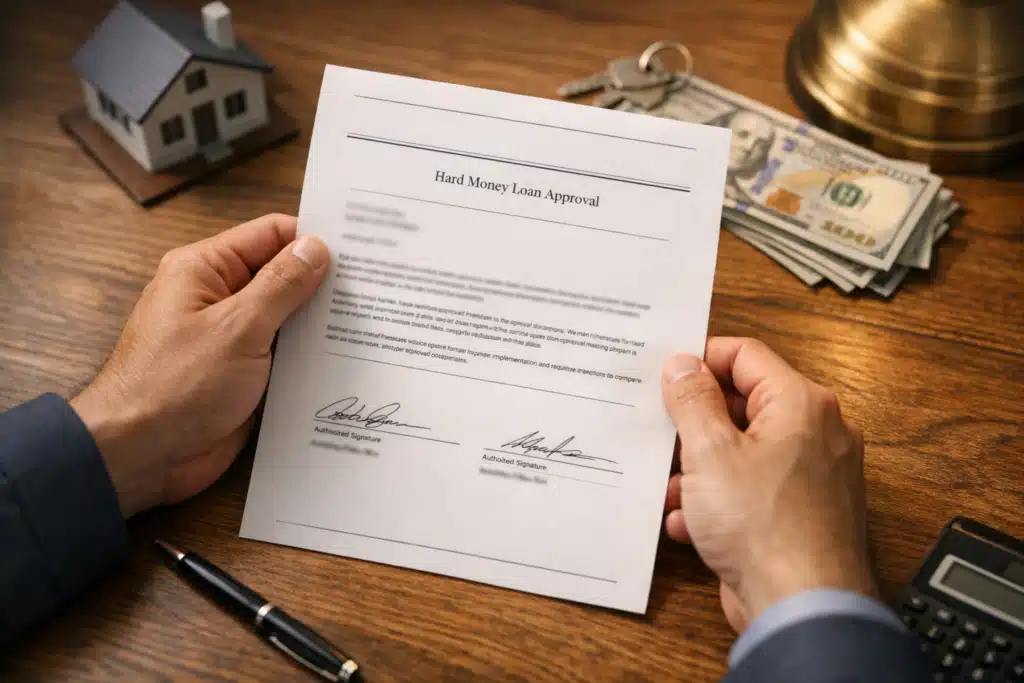
Winning bidders must typically provide full payment within 24-72 hours. This requirement excludes most buyers who depend on conventional loans with 30-45 day closing periods.
Types of Cash-Only Auction Sales
Different auction formats create specific financing challenges:
- Courthouse foreclosure auctions: Same-day payment required, no inspection period allowed
- Online auction platforms: 24-48 hour payment window with remote closing requirements
- Tax lien auctions: Immediate payment for lien certificates or deed transfers
- Estate auctions: Quick closing demanded by probate court schedules
- Government surplus auctions: Federal and state agencies requiring rapid fund transfers
Speed Requirements for Auction Financing
Auction success depends on funding speed that traditional lenders cannot match. Hard money lenders can close loans in 3-7 days when all documentation is prepared in advance.
The fastest auction deals involve lenders who review properties before auction day and issue commitment letters valid for multiple potential purchases. This approach allows investors to bid confidently on several properties during active auction periods.
Documentation Speed Strategies
Experienced auction investors prepare standardized documentation packages:
- Financial statements updated monthly for immediate submission
- Property analysis templates that can be completed quickly for any target property
- Insurance agent relationships that provide same-day policy binding
- Title company partnerships specializing in rapid auction closings
- Legal counsel familiar with auction purchase requirements
Risk Assessment in Auction Property Financing
Hard money lenders evaluate auction properties differently than traditional purchases because inspection opportunities are limited. Lenders focus on location, comparable sales data, and the investor’s track record with similar projects.
Risk mitigation strategies include conservative loan-to-value ratios, typically 60-70% of estimated market value. This approach protects both lender and borrower if hidden property issues emerge after purchase.
Property Evaluation Without Full Inspection
Auction properties often cannot be fully inspected before purchase. Smart investors and lenders use these assessment methods:
- Exterior evaluation: Structural condition visible from public areas
- Public records research: Permit history, tax assessment changes, and violation notices
- Neighborhood analysis: Recent comparable sales and market trends
- Utility status verification: Water, electric, and gas service connection status
- Environmental screening: Flood zone maps and contamination database searches
Cost Structure for Auction Hard Money Loans
Auction financing carries higher costs than traditional hard money loans due to speed requirements and limited due diligence time. Interest rates typically range from 10-15% annually, with origination fees of 2-4 points.
Additional costs include expedited appraisal fees, rush title searches, and same-day wire transfer charges. These expenses are offset by the profit potential of acquiring properties below market value through auction purchases.
Fee Breakdown Example
A $200,000 auction property loan might include these costs:
- Origination fee: $6,000 (3 points)
- Expedited appraisal: $800
- Rush title search: $400
- Wire transfer fees: $150
- Monthly interest: $2,000 (12% annual rate)
Competitive Advantages of Hard Money Auction Financing
Hard money auction financing provides access to properties that most investors cannot purchase. Auction prices often reflect 15-30% discounts to market value because the buyer pool is limited to cash purchasers.
Investors using this strategy can acquire multiple properties quickly during active foreclosure periods. The speed advantage creates opportunities for portfolio building that would be impossible through traditional financing channels.
Market Timing Benefits
Economic downturns increase auction volume while reducing competition from cash buyers. Hard money financing enables investors to capitalize on these market cycles:
- Increased inventory: More distressed properties reach auction during economic stress
- Reduced competition: Fewer investors have immediate access to large cash amounts
- Price opportunities: Auction prices may fall below replacement cost
- Portfolio scaling: Multiple acquisitions possible during peak auction periods
Exit Strategy Planning for Auction Purchases
Successful auction property financing requires clear exit strategies planned before bidding begins. Most investors choose between quick resale (wholesale or retail) and rental property conversion.
Hard money loans for auction properties typically carry 6-12 month terms, requiring borrowers to execute their exit plans efficiently. Extension options may be available but come with additional fees and higher interest rates.
Quick sale strategies work best for properties requiring minimal repairs in strong market areas. Rental conversion suits properties in cash-flow positive neighborhoods where refinancing into permanent loans is feasible.
Conclusion
Auction property financing through hard money loans transforms real estate investors into competitive cash buyers capable of winning bids against all-cash purchasers. This strategy provides access to below-market properties that traditional financing cannot reach due to speed and inspection limitations.
Success requires preparation, conservative risk assessment, and clear exit planning. The higher costs of hard money auction financing are typically offset by the discount pricing available through auction purchases.
Ready to compete in cash-only auction markets? Contact Apex Money Lending Group at 720-365-4344 to discuss your auction property financing needs and develop a pre-approval strategy for your next opportunity.
Sources
- National Association of Realtors – Real Estate Market Data
- U.S. Department of Treasury – Government Property Auctions
- Freddie Mac – Housing Market Research

